
CLIMATE RESILIENT URBAN WATER MANAGEMENT SOLUTIONS
Introducing The Tree Nurturing System (TNS™)
Disruptive Climate Resilience Technology
Imagine a system that works like a sponge in nature. It soaks up rainwater, cleans it, and gently releases it to where it's needed most - our urban trees and plants. This smart system not only waters the greenery but also lets the excess water seep down to replenish underground water sources.
The combined systems of soil, water, and vegetation, known as blue-green (living) infrastructure, have the ability to moderate the release of water during periods of heavy rainfall and provide an extra source of fresh water during heatwaves. This aids in fostering vegetation growth, expanding tree canopy coverage, and lowering urban heat temperatures.
Reinstating the sponge function in urban landscapes yields a multitude of benefits. These include increased resilience to floods and droughts, reduction of erosion, enhancement of biodiversity, regulation of local temperatures, and improvement of social amenities. It also promotes health and well-being, ensures clean water availability, and boosts local economies.
Unlike conventional drainage systems, the Tree Nurturing System (TNS™) is a decentralised approach. This decentralisation significantly reduces the displacement of flows and volumes, mitigating the negative impacts associated with rapid runoff and pollutant mobilisation by a magnitude of scale.

Background: The Impact of Drainage on the Natural Water Cycle
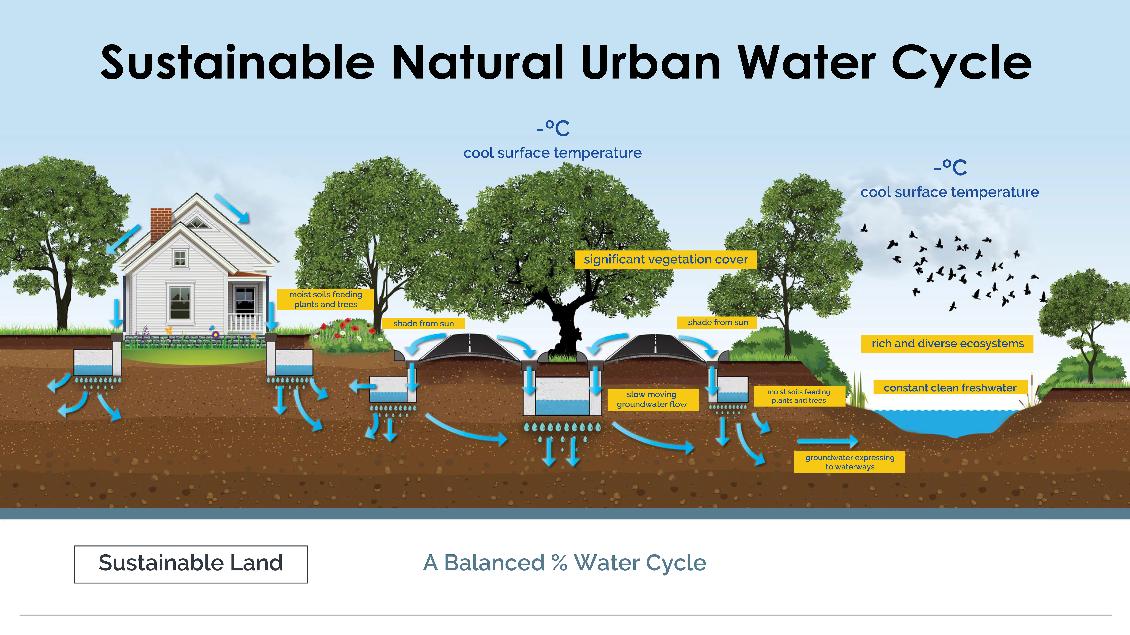
The natural water cycle on land involves the gradual movement of rainfall through the soil and underlying geology. Water infiltrates into the ground, moving slowly downwards to recharge groundwater and laterally through layers above less permeable rock.
Along the way, it seeps through porous voids across the landscape — within soil, vegetation litter, stones, cracks, and depressions — where it is temporarily stored.
This process holds rainfall back, reducing the speed and volume of runoff. Only during major rainfall events, when the soil becomes saturated, does excess water begin to flow across the surface into creeks and rivers. The movement of underground water is slow, taking days or weeks depending on soil permeability, vegetation cover, and geological conditions, forming a steady and balanced part of the natural hydrological cycle.

The Conventional Urban Water Cycle
Conventional drainage, a centralised approach that focuses on removing water from a single, central point, exacerbates the displacement of flows and volumes. This displacement can lead to a variety of environmental problems, including soil degradation, water pollution, and loss of biodiversity.

Drainage, defined as the natural or artificial removal of a surface's water and sub-surface water from an area, is a crucial aspect of urban planning. Traditional urban drainage systems, while efficient at removing water from urban areas, have significant drawbacks. They enable quick and easy mobilisation of pollutants and contaminants, which are collected and conveyed downstream, detrimentally impacting the health and function of the receiving environment.
Moreover, these systems starve upstream catchments of rainfall, leading to dead and barren soils. Groundwater levels fall deeper and deeper, and starved of water, these soils exhibit no oxygen, other minerals, and elements. Subsequently, vegetation root systems are shabby and unable to support and sustain life, these soils become hard and compacted.

Conventional Drainage is killing street trees
The impact on urban trees is particularly severe. Many urban street trees are planted in shallow graves, surrounded by hard compacted engineered soils. The root zones of these trees lack water, oxygen, and minerals, leading to declining health and immunity towards pathogens. Trees easily become infected with pathogens such as phytophthora, which are conveyed within overland flows, deposited onto tree root runners, or concentrated at captive points along the flow path. Being the only source of water for uptake through the root zone, the pathogens easily attack the tree cell structure, slowly and surely leading to certain death. Without a healthy dense root mass, trees lose stability and support to hold the trunk and canopy above, leading to failure and collapse. In many urban areas, this results in the death of innocent community members.
Community and Environmental Costs of Traditional Drainage Practices
The traditional approach to drainage has become standardised across the globe, driven by cost and efficiency considerations. However, this approach overlooks the critical role of the natural water cycle in maintaining healthy urban ecosystems. By disrupting the natural water cycle, traditional drainage systems contribute to a range of environmental problems, including soil degradation, water pollution, and loss of biodiversity.

In addition, the adoption of a traditional drainage approach results in a significant end of line drainage maintenance regime along with costly, time consuming and insufficient manual irrigation practices.

The Sustainable NaturalUrban Water Cycle
To address these challenges, a paradigm shift is needed in urban stormwater management. This shift involves moving away from traditional drainage methods and embracing ingenious approaches that promote the health and longevity of soil, vegetation, and water systems.
Our TNS™ aims to replicate natural processes, promoting the infiltration and retention of stormwater at the source, rather than rapidly removing it from urban areas. This approach reduces the volume and velocity of stormwater entering traditional drainage systems, mitigating the negative impacts associated with rapid runoff and pollutant mobilisation.
Re-introducing Cultural Water Values
Through our TNS™ and source-control philosophy, we move beyond conventional conveyance models to restore balance within the urban water cycle. This approach re-introduces Cultural Water Values — principles long recognised but seldom realised in practice.
Our system aligns with the growing national and international recognition that water is a living system, intrinsically connected with land, culture, and community.
Frameworks such as Australia’s National Water Initiative (2004), the Insights Paper – Pathway to Enduring Recognition of Aboriginal Peoples’ Water Interests (2022), and the forthcoming National Water Agreement all call for stronger integration of these values in modern water planning and management.
Despite these policy commitments, most stormwater systems continue to prioritise rapid conveyance, moving water away from where it falls. Our approach reverses that logic. By slowing, storing, and sinking runoff, we reconnect urban environments to natural hydrological processes — reflecting the enduring principle that water should return to Country and sustain life. This practical alignment supports the intent of both federal and state strategies to embed Cultural Water Values within contemporary urban water management.
By restoring balance through cultural and ecological principles, the TNS™ translates these values into a practical urban form. Its modular design — built to work with natural processes rather than against them — brings this philosophy to life beneath the street.
Modular Design Beneath the Street
Unlike conventional drainage, the TNS™ is modular — like Tetris beneath the street. Each unit manages its own micro-catchment, the smallest possible scale of runoff. Units can be arranged wide or narrow, deep or shallow, and configured to work independently or in connection with others.
Sections can be added, removed, or rearranged to suit local space, grade, and site constraints, making TNS ideal for retrofitting existing streets without costly excavation or redesign.
This modularity allows the system to adapt to any environment, from dense urban streets to open landscapes, while maintaining consistent infiltration and water quality performance. It provides a practical bridge between policy intent and real-world implementation — reconnecting urban design with the principles of the natural water cycle.
What makes the TNS™ different from other tree pit devices?
Our TNS™ distinguishes itself from other tree pit devices with its exceptional high inflow rate and comprehensive approach to stormwater management, enhancing the health and longevity of soil, vegetation, and water systems.
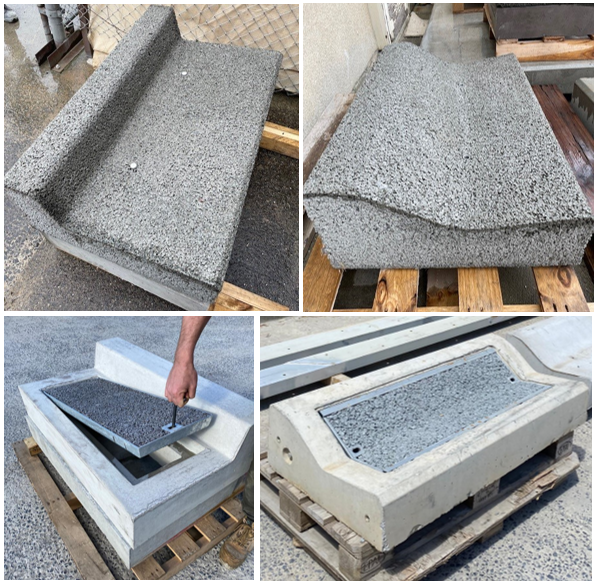
Meet the fully porous EnviroKerb™ from Precast Permeable Concrete (PPC) Australia (www.envirokerb.com.au). It's like a powerful, eco-friendly sponge made from special concrete. Placed along kerbsides, it acts as a super filter for rainwater, cleaning it as it flows. This clean water then reaches the trees and plants, helping them thrive. What makes it stand out? The EnviroKerb™ showcases an impressive inflow capacity of about 30,000mm per hour or 500mm per minute. This high inflow rate significantly surpasses other tree pit systems, which often exhibit substantial bypass flows and very low inlet capacities.
More notably, the EnviroKerb™ effectively filters stormwater runoff before it enters the tree pit, providing a treatment efficiency that significantly surpasses other tree pit systems.
Studies indicate that porous media, with its voids that collect oxygen, nutrients, and minerals, supports algae and bacteria populations. These organisms feed on runoff contaminants, including hydrocarbons, resulting in the removal of approximately 98% of pollutants from stormwater runoff.
When runoff is intercepted under a shallow sheet flow regime, the constituents of the runoff are microscopic. This minimises the chance of constituent accumulation and ensures high flow rate performance over an extended period.
The removable trayEnviroKerb™ Stormwater Pollution Prevention Inlet (ESPPI) component of the TNS™ acts as a protective barrier for our waterways and oceans, safeguarding them from plastic, litter, and other substantial pollutants. Unlike conventional drainage systems, gross pollutants do not enter a drainage pit and pipe system. Instead, they remain in the tray of the porous kerb. The TNS™ significantly reduces maintenance costs compared to pit and pipe drainage infrastructure, with only a street sweeper required for the collection of gross pollutants.
The key differentiator of the TNS™ is its decentralised stormwater management approach, which reduces the negative impacts of conventional drainage systems by a magnitude of scale. Based on this, the Tree NurturingSystem™ can be customised to handle both minor and major rainfall runoff storm events, even that equivalent to a 100-year storm event. This is made possible through the integration of a range of proprietary stormwater management solutions.
This stormwater management capability, which includes runoff retention, distributed detention, and slowing down the water, significantly reduces flood risk, replenishes groundwater systems, and protects downstream water systems, all while maintaining ecosystem health.
Four BGI modular variants
Blue-Green Infrastructure offers four modular variants of the TNS™. These variants integrate proprietary modular tank, structural cell, and drainage void systems.


This patent is made, and the Tree Nurturing System (TNS™) trade mark is used, under licence from BLUE GREEN INFRASTRUCTURE Pty Ltd ACN 648 262 373
© Copyright BLUE GREEN INFRASTRUCTURE Pty Ltd (ACN 648 262 373)